
Day 1: Resume Building That Works
GET EYES ON YOUR RESUME!
Today’s goal is…
To write a resume that's tailored for Production roles.
Chapters:
#1 Why Start With a Resume?
#2 Unpacking the Resume
#3 How to Build a Resume
#4 How to Write Your Experience…even when you don’t have much.
Gear Check:
• Resume Template
• Resume Power Words
• Resume Checklist
• Write the Right Details Worksheet
1.1: Why Start with a Resume?
To get the ball rolling, start with your resume first.
HERE’S WHY:
It forces you to list the actual tasks, experiences & skills you did, before you get inundated with a list of other “expectations.”
These points become more natural for you to write and to say in interviews —less likely to forget.
It’s a baseline of your strengths and an early confidence boost!
It helps show which jobs you’re suited for.
You need it right away. It does the work while you’re on the hunt.
The first step is only a draft. Tailoring will come later.
Easier to draft when just jotting down from memory.
It gets you started.
-
Preparing to do the thing isn't doing the thing.
Scheduling time to do the thing isn't doing the thing.
Making a to-do list for the thing isn't doing the thing.
Telling people you're going to do the thing isn't doing the thing.
Messaging friends who may or may not be doing the thing isn't doing the thing.
Writing a banger tweet about how you're going to do the thing isn't doing the thing.
Hating on yourself for not doing the thing isn't doing the thing. Hating on other people who have done the thing isn't doing the thing. Hating on the obstacles in the way of doing the thing isn't doing the thing.
Fantasizing about all of the adoration you'll receive once you do the thing isn't doing the thing.
Reading about how to do the thing isn't doing the thing. Reading about how other people did the thing isn't doing the thing. Reading this essay isn't doing the thing.
The only thing that is doing the thing is doing the thing.
source: Strangest Loop - link
1.2: Unpacking the Resume
Here are the typical parts of a resume and what they’re for.
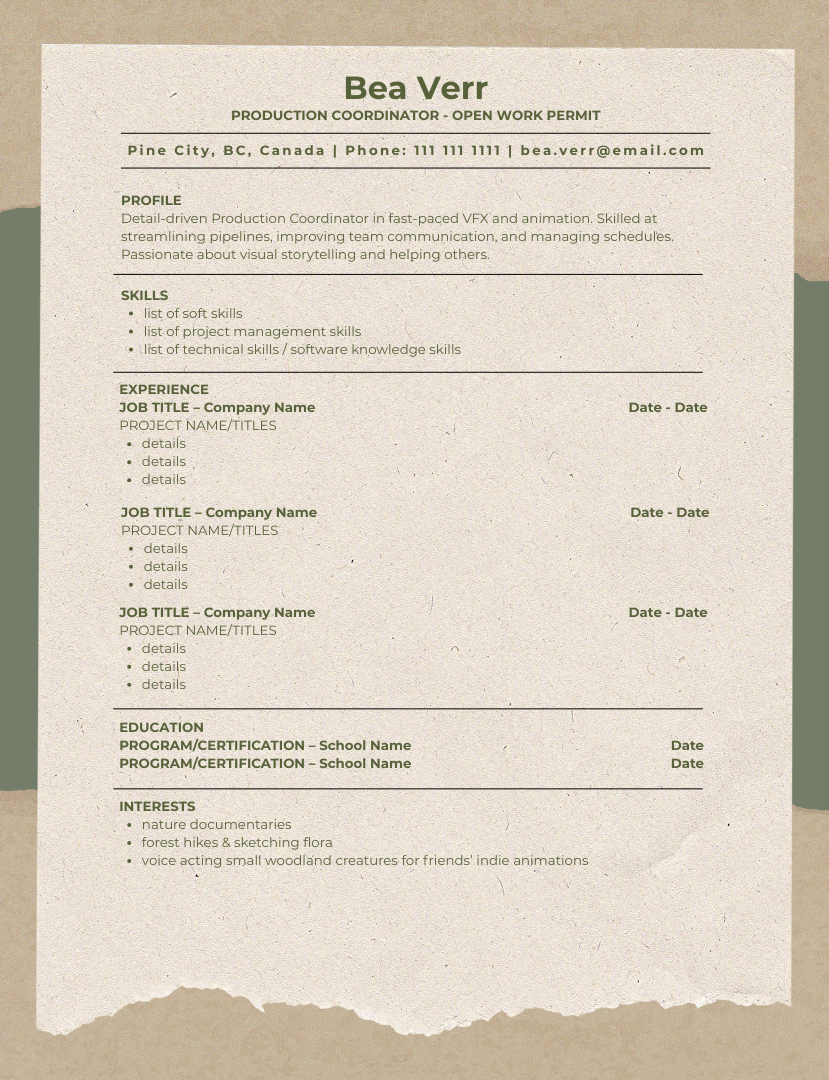
PARTS OF A RESUME:
Must haves:
FULL NAME
CONTACT INFO
City, state/province, country, phone number & email.BIO / PROFILE
NOT just an objective. Small blurb on who you are.WORK EXPERIENCE
Role title, company name, date, show title—not the alias.
Task details, contributions, & relevant skills.EDUCATION
No need for in-depth detail / GPA.SKILLS
Optional:
ROLE: current or role that you’re seeking
WORK ELIGIBILITY: if comfortable with sharing, could help in ATS.
LANGUAGES: can be added to SKILLS
INTERESTS / VOLUNTEER EXPERIENCE
WEBSITE / LINKEDIN PROFILE
No, you do not need demo reels for Production roles.
CAVEAT: Notes are based on typical resumes in North America (mainly US and Canada). Practices may vary by location.
Got a question? Ask us in chat!

1.3: How to Build a Resume
STEP BY STEP GUIDE
STEP 1: Open a word document.
STEP 2: Write your Name and Contact Info at the top.
(Optional: Add your role, work eligibility, website)
STEP 3: Add your city, state/province & country for the ATS.
STEP 4: Write a short Profile summary (bio).
Who you are, your experience, goals, and highlights.
STEP 5: List your Work Experience.
See Ch1.4 on How to Write Your Experience.
STEP 6: Write your Educational background. Be brief.
Course/program name, school, date. No GPA.
STEP 7: List your Skills in bullet points.
STEP 8: Include Optional sections like Interests & Volunteer Work.
STEP 9: Save as a PDF file with an appropriate file name.
STEP 10: Proof read it and share for a peer review.
-
✓ It’s plain. Use simple fonts and format.
No graphics. No colours. No columns.
✓ Clear contact info. Correct email and phone number.✓ Using standard headings.
e.x.) PROFILE, SKILLS, WORK EXPERIENCE, EDUCATION, INTEREST✓ Profile summary (bio) is only 2-3 sentences.
✓ The experience listed are relevant to the role you’re applying for.
✓ Duties align with the job description of the role you’re applying for.
✓ Job descriptions start with a verb.
✓ There are job details that are quantifiable.
✓ There are no 1-2 words that are “hanging” or taking up an entire text line / row. Smart use of the resume’s real estate.
✓ Skills have items that can be categorized in:
(1) SOFT SKILLS
(2) PROJECT MANAGEMENT SKILLS
(3) TECHNICAL SKILLS / SOFTWARE KNOWLEDGE
BONUS: Languages are skills too!
✓ Little to no repetitive words.
✓ It’s easy to read.
Can someone read it in ≤10 seconds and get enough info?
✓ It’s saved as a PDF.
✓ The file has been renamed appropriately.
✓ Someone else has proof-read it.
✓ Resume and LinkedIn profile details match.—
PROD TIP: This checklist is printer friendly! Grab a copy from your gear pack when you access the course materials. Get the link here. -
Here’s a few file name suggestions using the example from Ch 1.2!
BeaVerr_Resume.pdf
BeaVerr_Resume_StudioName.pdf
BeaV_Resume_ProductionCoordinator.pdf
PROD TIP: Keep track of your versions and always double check that you’re submitting the correct one.
It doesn’t have to be perfect or final.
You can edit it again later.
1.4: How to Write Your Experience
NOT ALL EXPERIENCES ARE EQUAL
Just because you did a task, it doesn’t mean it’s relevant.
Highlight how the task added value and supported the team — if it's useful in a production role now, include it.
Overall Notes
•List experiences with the most recent one at the top.
•Always include start and end dates —month and year.
•If possible, list the job title, company name, and show title
•It doesn’t have to be full sentences; no paragraphs.
•Use bullet points. 1-2 rows/lines per point.
WRITING THE DETAILS
STEP 1: Pick a task/duty you did well, or a problem that occurred.
STEP 2: For each one, write the result that you helped create after completing the task/duty. If it was a problem, what was the outcome?
STEP 3: Write a skill or tool you used in Step 2 that is also a skill or tool mentioned in the job description of the job you’re applying for.
STEP 4: For each skill or tool, pick a verb or power word that describes how you exhibited the skill or used the tool.
STEP 5: Use the formula below to string steps 1-4 into one bullet point.
THE FORMULA
step 4 + step 3 + step 1 = step 2
-
ALTERNATE FORMULA:
< verb/power word > + < skill/tool > + < task or problem > = < result >
EXAMPLES:
PROD TIP: Where possible, quantify to elaborate on the impact/scale.Tracked 300+ assets for a 10 episode series using ShotGrid and ensured asset readiness in time for animation’s episodic kickoff.
Facilitated effective cross-departmental communication between layout, animation, and editorial to streamline workflow.
Diligently maintained task statuses and notes in ShotGrid to keep teams informed and production’s end of week reports accurate.
Scheduled check ins for a team of 50 people spread between multiple locations, improving team synchronicity and morale.
Use the Write the Right Details Worksheet in your Gear Pack to draft!


DID YOU KNOW?
Even though role titles are the same, the actual duties, roles & responsibilities of these positions may still vary per studio or per show. So, always read the job description if it’s a fit.
-
Apply for internships.
Take jobs that practice team management, scheduling, or project management skills —even if it’s outside the industry.
Do volunteer work (see volunteering events here.)
Take courses that are related to pipeline knowledge or production management.
Connect with industry professionals on LinkedIn.
-
For emerging talent (≤ 2/3 years of experience in a Production role), yes.
Most productions (aka projects) can run between half a year to 2/3 years, so even after getting your first gig, there may not be a lot to beef up your resume if you’re only sticking to industry related experiences.
For this reason, it’s worth taking a look at your past experiences, even if they’re outside VFX/animation, to see if there are transferable skills in your past that can help you in a production role today.
As you gain more experience in the industry, you can phase them out.
-
To an extent, yes. Note the department you were in and mention that this gives you a deeper understanding of the pipeline, but do not write too much about artist-focused tasks.
If applying for a Production role, I am much more interested in skills/experiences that are closer to the responsibilities assigned to Prod than what you did as an artist. So, be sure to read the job description to pick up on what is relevant to you and the role you’re applying for.
-
You can, but it has very little impact, so I generally don’t.
Awards and scores may not mean the same way or may not mean anything at all depending on who’s looking at it. My advice is that that real estate is better spent on a more thought out details for your profile, experience, or skills. -
That’s great! Congratulations on starting a new adventure!
If you’ve been working at the same company for a while, chances are your job title or role would have changed throughout the years too.
You don’t have to lump it all in one just because it’s under one employer. This may get messy, hard to read, and confusing. Each hat you wore had responsibilities of their own, so highlight that.
You can break up your experience per job title and emphasize the key contributions you did when you were in that role.
PROD TIP: Play around with formatting so you’re not having to repeat the company name over and over —avoid clutter!
-
Short answer: Yes.
Long answer: Yes, but you don’t have to start from scratch all the time. You can optimize this by being familiar with your own resume and switch up keywords to match it closer to the role’s job description while still making sense and without needing to overly rewrite. -
The choice is up to you.
But what I can give advice on is that if you choose to use AI, do spend time to read and edit for accuracy and personalization.
Also ensure that there is congruency between what’s on your resume, cover letter, LinkedIn profile, and what you say in an interview.
-
Applicant Tracking System
A type of software that studios use to manage job applications through its ability to scan, filter, and rank resumes based on specific words.
This is why formatting and writing relevant content are especially important as some resumes will not reach “human eyes” at all if certain keywords are not met through search or filters. To be fair, recruiters also receive hundreds of applications everyday and it’s also not “humanly” possible to read each one in a timely manner.
While it may be boring to look at, text-only and simple font/format are what work best with ATS. Images, tables, fancy fonts and colors do not. But what helps the most are keywords that match the job description of the role you’re applying for.
—
“..[a] simple test is CTRL-A, CTRL-C then CTRL-V into a… text editor. If the text mixes text and breaks up sentences, it is not ATS "readable." - Reddit
-
Use at your own risk.
Be careful not to affect resume text parsing. It’s safest and more reliable to keep it clean: no graphics, no complex design, no columns, no colour.
While creativity and “looking nice” can make it memorable for a human reader, if it’s poor in ATS, it may not even reach any human reader at all.
-
PDF is the way.
Docs are unreliable and may break/change the formatting and font depending on the software used —you can’t guarantee that everyone in the hiring team has access to MS Word.
PDF on the other hand, preserves your desired formatting.
-
Ideally 1 page, but not always.
Remember that the goal is readability.If you have a lot of relevant experience and condensing it all into 1 page makes it difficult to read, then that defeats the goal. 2 pages is acceptable.
If you’re expanding to seem like you’ve had a lot of experience, you’re repeating details, absurdly formatting gaps/font sizes to fill the space, embellishing or adding things that are NOT relevant to the role, stick to 1.
Personally, I do not expect anyone who has had less than 2-3 years of experience in a Production role to need more than 1 page.
It’s not just about duties.
Every bullet point needs to have a purpose.
-
Relevant tips for production. Click on the number for more info.
—
#109: Read the job description of your role even if it's from another studio.
#219: You don't have to list all your work experience and education on your resume.
#297: Make sure that what's on your resume is relevant to the role you're applying for.
#298: Include your location on your resume.
#299: At the top of your resume, add a little bio or profile blurb about who you are.
#300: Soft skills and people skills matter too. Don’t forget to add them in your resume.
#303: Don’t just list tasks on your resume.
#308: Clean up the file name before uploading your resume.
TIP:Mention the departments you worked with as a PA or PC.
TIP: Describing your work experience is not just about duties. It’s about showing off your skills and how it can benefit your future team.
TIP: Where possible, quantify the result or impact of your task/duty or how you helped resolve a problem.
-
Anecdotes from the real life.
—
Don’t be discouraged if your background is NOT in film/TV/VFX/animation. In the many years I’ve been in the industry, I’ve worked with Production peeps whose work experiences drastically varied between retail, poli-sci, engineering, food —even cheerleading! What’s important to showcase is HOW you are a fit based on the skills and responsibilities the job is looking for.
When I was starting out, I would have 3 different resumes.
(1) For retail - my part time job(s)
(2) For admin roles - for jobs outside the industry but can train me in project management and administrative roles
(3) For Production roles in VFX/animation/gamesI once received a resume where the only things written on it were their name, email, school, and accolades. The whole content took up maybe 1/5 of the page. I’m not sure if it was a true attempt or if it was an early version sent by mistake. They did not move forward.
Feeling weird “bragging” about yourself on your resume? You’re not alone! It’s normal, but do it anyway —Just read this post from Reddit.
-
Here are the main takeaways from today’s camp.
Start with writing your resume first. Edit as you go later.
A resume should have your name, contact info, summary, experience, education, and skills.
The resume needs to be skimmable and easy to read. Improve readability as much as you can.
Resumes need to be tailored for a Production role. Match the keywords found in the job description of the job you’re applying for.
Production skills are highly transferrable and you can find relevant experiences from your past if you know where to look.
-
SOY is not affiliated with the external links below, but these references are listed here in case they may be helpful to others.
—
Videos by Emily Yakashiro, A Course in Production
Podcast episode by Virginie Lavallée, The Happy Producers
—
GUIDED TRAIL - COME WALK WITH ME!
Action Items:
No. 1: Fill out the worksheet: Write the Right Details.
No. 2: Draft your resume based on the template provided.