
Day 2: Resume What Not to Do's
THE OPPOSITE OF YOUR CHECKLIST.
Today’s goal is…
To review your resume and avoid these mistakes.
Chapters:
#1 What Not to Do in General
#2 What Not to Say About Yourself
#3 What Not to List In Skills or Experience
#4 Education & Interests Don’ts
NOTE: These are based on typical resumes in US and Canada. Practices may vary by location.
Gear Check:
• Resume Do Not Do List
2.1: What Not To Do In General
OVERALL NOTES
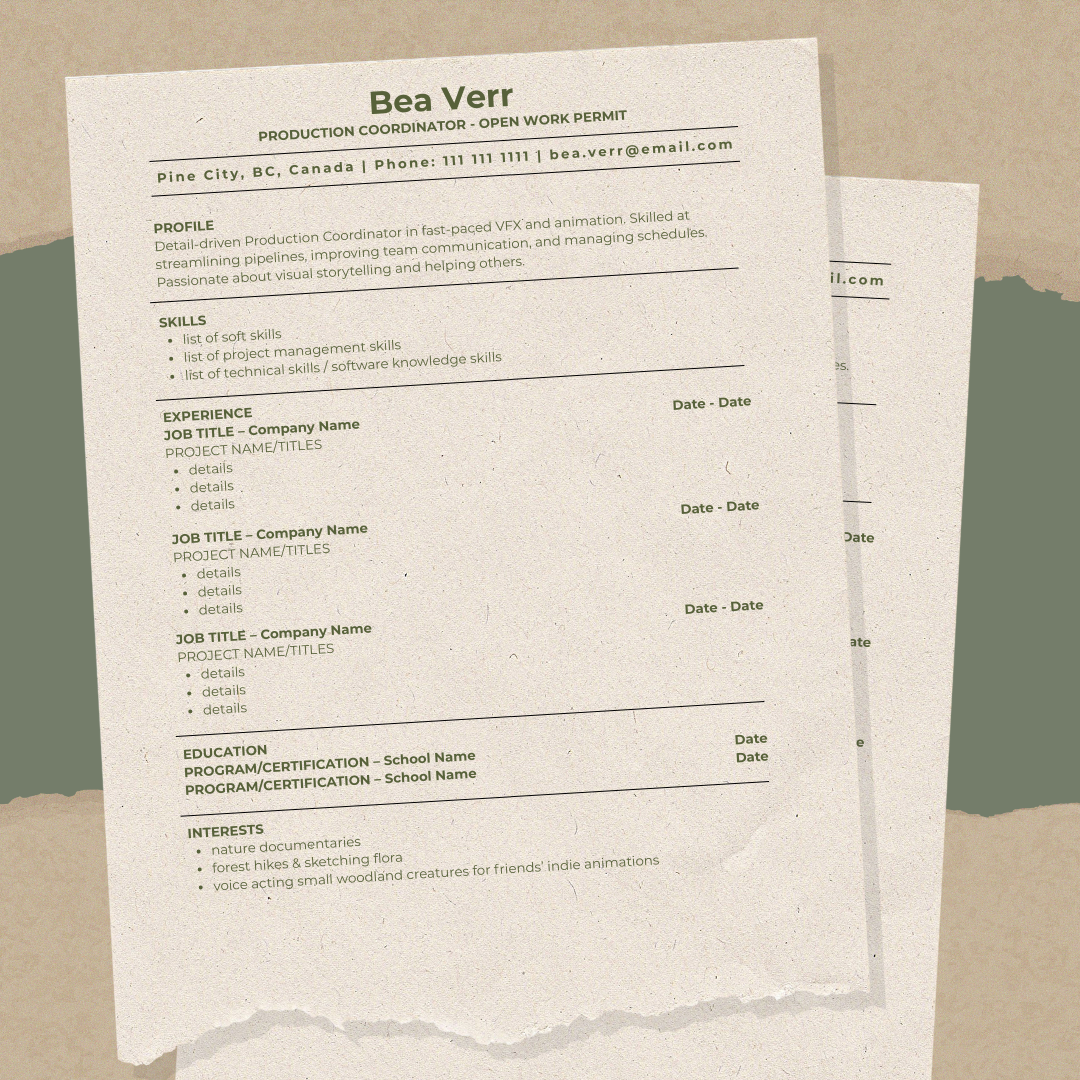
✘ Avoid walls of text. Be concise but high-impact.
✘ Avoid redundancy and repeating phrases.
✘ Avoid formatting inconsistencies —it makes it hard to read.
✘ No pictures.
✘ Don’t skip proof-reading.
✘ Don’t forget to rename your file.
✘ Avoid anything but a PDF format, if possible.
✘ Don’t forget to thank people who helped you.
✘ Don’t miss a deadline for submission.
✘ Don’t wait too long before sending.
Sometimes, good enough is good enough.
Let your resume do the work while you work on improving it.

Optimize for readability.
Make it easy to follow and be reviewed in seconds.
2.2: What Not To Say About Yourself
Profile & Contact Info Notes
✘ Don’t make the font size too small or hard to read.
✘ Don’t use an unprofessional email.
✘ Don’t forget to check that links work.
✘ Don’t add your age or birthdate.
✘ You don’t need to put your full address.
City, state/province, and country will suffice.
✘ Don’t put your salary expectations on your resume.
It’s usually reserved for online forms, interviews, or correspondence.
✘ Don’t just talk about what the studio or opportunity can do for you.
Highlight what YOU can bring to their team.
“Writing a resume is like making a film —you’re telling a story.”
Its purpose is to get you an interview.
Make them want to meet you!
2.3: What Not To List In Skills & Experience
On Content
✘ Don’t forget to add the start and end dates.
✘ You don’t need to write the length of time per experience.
The start and end date will suffice.
✘ Don’t forget to add your previous job title and company name.
✘ Don’t forget to list your previous project’s show titles.
✘ Don’t skip reading the job description.
✘ Don’t skip tailoring your resume to the job.
✘ Don’t forget to add quantifiable outcomes.
✘ Don’t forget that people skills matter for Production roles too.
It’s not just all technical, note taking, scheduling, etc.
✘ Don’t dismiss non-industry experience. Production skills are highly transferable. Look again and pick up what’s applicable.
✘ Don’t repeat the same skills or phrases over and over.
Even if you’ve taken similar roles with similar tasks.
✘ Don’t use vague or “fluff” words without substance or examples.
Same goes for skills without context.
✘ You don’t have to say your proficiency in languages.
Languages are GREAT to add, but be smart about the real estate of your resume. De-clutter and save the details for the interview.
PROD TIP: Do not expect the recruiting team to translate your experiences for you on how it can be applicable for the role. Your resume should be explicit in drawing how your past skills are relevant.
On Formatting
✘ Don’t forget to list in chronological order; most recent at the top.
✘ Avoid using 3+ pages but listing experience that’s irrelevant to Prod.
✘ Don’t make the font size too small just to fit it all in one page.
If you have an appropriate amount of experience, 2 pages is ok.
✘ Don’t just list your duties. See the formula here.
✘ Avoid having more than 3 sentences per bullet point.
✘ Avoid having 1-2 words take up a whole text row.
Condense or elaborate to better use space.
✘ You don’t have to use full sentences to list skills and tools.
✘ Don’t over use bold, italics, or underline. It’s hard to read.
Sometimes, less is more.
The less text clutter there is, the easier for eyeballs to see your skills.
-
Examples of how I would tweak some resume excerpts…
Sample: “Took notes and distributed it to the team.”
FP NOTES: How well did you take notes? What kind of notes and what were they for? How was it helpful?
Fix: Proactive in note taking in external calls/emails as well as internal reviews. Notes are clear & timely to avoid idle time for artists.
—Sample: “Scheduled and helped the team with meetings.”
FP NOTES: Scheduled what? Helped how? How big is the team? What kind of meetings and how often?
Fix: Consistently coordinated weekly client reviews for the design department ensuring constant flow of feedback and asset approval.
—Sample: “Proficient in Excel, Google Sheets, and Shotgrid.”
FP NOTES: What for? What’s your level of expertise? Why does it matter?
Fix: Created shot tracking pages in Flow (ShotGrid) and optimized data exports in Google Sheets to streamline accurate EOW reports.
Examples of how I would tweak these resume excerpts.
2.4: Education & Interests Don’ts

Other Notes
✘ Don’t forget to add the school year.
✘ Don’t forget to list in chronological order; most recent at the top.
✘ Don’t write your GPA.
✘ You don’t need “references available upon request.”
✘ Don’t overshare in your interests.
Survival Motto: Imperfect but in progress
There’s always more to be done but don’t get caught in a loop of redos!
You get nowhere if nobody sees it. So, get it out there. CBB and hit SEND.
-
Relevant tips for production. Click on the number for more info.
—
#109: Read the job description of your role even if it's from another studio.
#219: You don't have to list all your work experience and education on your resume.
#297: Make sure that what's on your resume is relevant to the role you're applying for.
#298: Include your location on your resume.
#299: At the top of your resume, add a little bio or profile blurb about who you are.
#300: Soft skills and people skills matter too. Don’t forget to add them in your resume.
#303: Don’t just list tasks on your resume.
#308: Clean up the file name before uploading your resume.
TIP: Mention the departments you worked with as a PA or PC.
TIP: Describing your work experience is not just about duties. It’s about showing off your skills and how it can benefit your future team.
TIP: Where possible, quantify the result or impact of your task/duty or how you helped resolve a problem.
TIP: Some job openings have a due date for applications.
TIP: Make your resume quick to skim, but rich in value.
TIP: When you highlight everything, you highlight nothing. Easy on the font formats and don’t go overboard with bolding, italics, and underlines.
TIP: You don’t add your photos when submitting resumes in US or Canada.
TIP: Always proof-read your resume.
TIP: More than one page for a resume is okay as long as the content is appropriate.
TIP: You don’t need to put your full address on your resume.
TIP: Your resume’s job is to get you an interview.
TIP: Read the job description and match your resume to it.
TIP: Vague fluff words without context or examples adds little value to your resume.
TIP: Optimize the real-estate on your resume.
TIP: GPA numbers may not mean anything to the hiring team.
TIP: You don’t need references on your resume.
TIP: Interests on your resume puts a human touch on a faceless doc. But keep it professional.
TIP: Sometimes, resumes are good enough to send, and you can circle back to edit later. Done is better.
-
Anecdotes from the real life —DO NOT DO THESE.
—
I personally made the mistake of sending my own resume highlighting my “attention to detail” and then later noticing typos in it.
Someone applied with a resume that only had a link to their website.
While reviewing multiple applicants, I downloaded a handful of resumes sent to me by HR for review. One was promising, but it took some time to find it again because the file names were all named “Resume.doc” “Doc” “productioncoordinatorresume.pdf”
PROD TIP: Read this for file name suggestions.If you’re conflicted between pursuing a Production role or an artist role, your resume might reflect that too and it makes it confusing or misleading. If you try to be both in 1 resume,you get neither. So, be sure to tailor your resume to each job position you’re applying for so that your strengths for each specific role is better presented and understood.
I’ve read resumes with a list of experiences and detailed descriptions of their duties —none of which had anything to do with Production.
PROD TIP: It’s the resume’s job to show how your experience is relevant to the role you’re applying for.For funsies, others have shared some of their own anecdotes here —an applicant sending a CV dating back to 5th grade is wild!
-
Here are the main takeaways from today’s camp.
Overall, make your resume very easy to read. If someone says they don’t know where to look, it’s time for a major edit.
Small details matter too. Check for typos, file names, contact info, and other ways to optimize space via formatting or rephrasing.
Don’t overwork your resume so much that you don’t move forward at all. Send it out once it’s good enough, and come back to edit it again later. At least it’s out there!
Resumes tell a story. Make the readers envision you excelling in the role but also fun to work with that they would want to meet you.
Always read the job description.
-
SOY is not affiliated with the external links below, but these references are listed here in case they may be helpful to others.
—
Reasons Why You’re Not Getting Job Interviews - Advice with Erin
Rookie Mistakes: Prioritizing Technical over Soft Skills - Emily Yakashiro, A Course in Production
—
GUIDED TRAIL - COME WALK WITH ME!
Action Items:
No. 1: Cross-check your resume with the Do Not Do List. Edit.
No. 2: Give yourself a treat for finishing a resume! Nice work!