
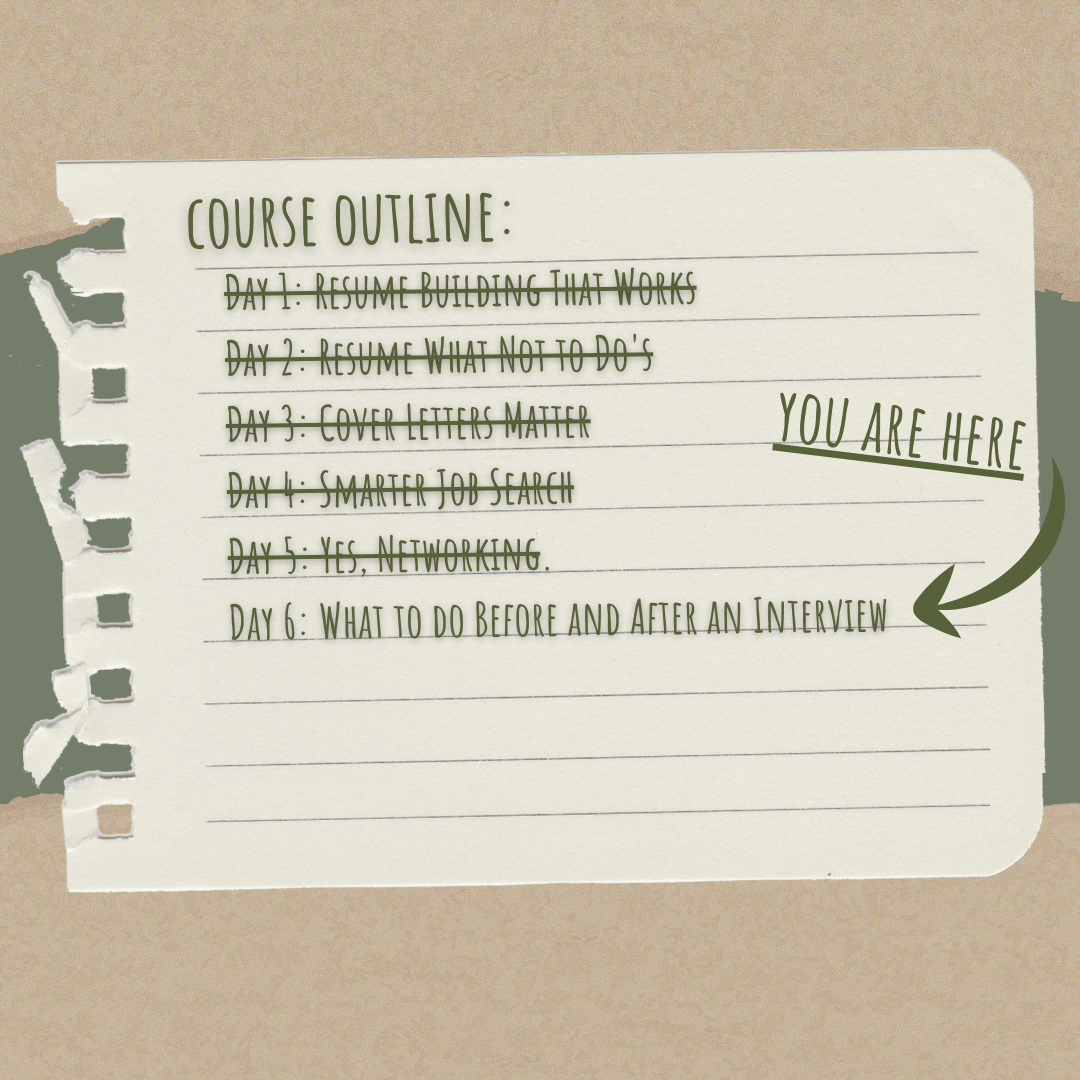
Day 6: What to Do Before and After an Interview?
PREP WELL AND FOLLOW UP
Today’s goal is…
To learn how to prepare for all phases of an interview.
Gear Check:
•Checklist Before the Interview
•Checklist After the Interview
•Interview Questions for Prod
6.1: Interview Etiquette 101
How to present yourself in an interview.
Don’t just wing it. Unpreparedness is a disrespect of their time.
Plan your environment, outfit, and setup accordingly.
For virtual calls, let them know what they can’t see.
If you’re taking notes or have notes on another screen, let them know that that’s why you’re looking away from the camera.If you’re running late, communicate. Let them know.
Treat everyone with respect, not just the interviewers.
NEVER bad mouth a previous studio or employer.
Keep answers relevant and to the point.
Be mindful of the time allotted for the interview.
Prod are meeting time gatekeepers —show them in practice.Follow up with a “thank you” message within 24 hours.
Mention something from the meeting; don’t just copy/paste.Let them know if you’re no longer available.
If they didn’t think you have what it takes,
they wouldn’t ask you for an interview.
Breathe. You’re already a fit for the job on paper —now you just have to SAY it to them.
6.2: What You Should Know Before an Interview
BEFORE your interview starts, make sure to sign your NDAs and…
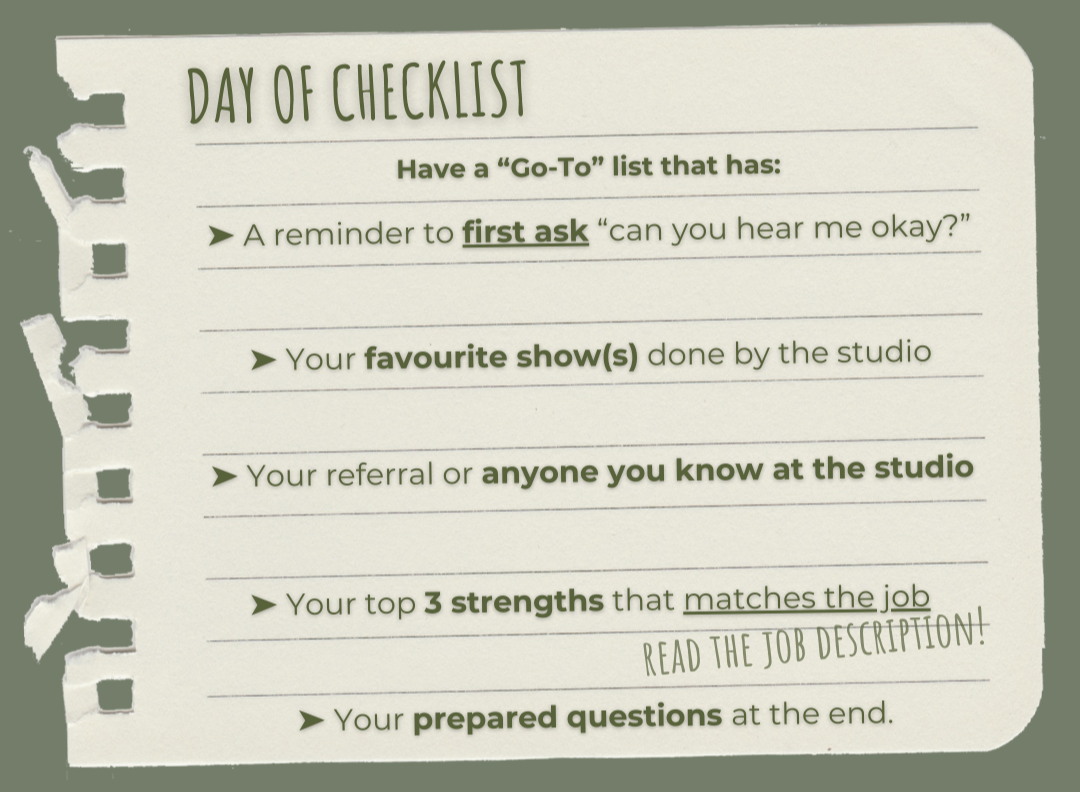
✓ Read the job description. Know what they’re looking for.
✓ Browse the studio website, values, & reel. Pick your favourites.
✓ Know any recent news about the studio.
✓ Have your own resume handy. Great save if you blank out.
✓ Set your phone to SILENT. Avoid distractions.
✓ Arrive or join the meeting early.
OPTIONAL:
✓ You can research about your interviewers, but don’t be creepy. Don’t stalk them. Keep it professional only to feed conversations.
-
About Yourself
Tell us about yourself.
Walk us through your resume.
How did you choose animation (or VFX) and why our studio?
How do you know (referral’s name)?
How much do you know about what Production does?
Why Production? What excites you?
In your current role, what are your current duties that are transferrable for this role?
What would you say your strengths are?
What is your work style like?
Tell me more about your experience in (something on your resume).
Is there something in your resume that you’re particularly proud of?
What’s your approach in learning about a process that you’re not familiar with?
If hired, what would you hope to learn or grow into in this role?
If there was one thing on your resume that we should really notice, what would it be and why?
Scheduling
How familiar are you with Shotgrid?
What’s a typical week for you in terms of maintaining the schedule?
What’s your process for managing calendars?
How are you with Google Sheets?
How do you stay organized and be on top of things?
How do you stay on top of your emails and chats?
Communication
What would you say your communication style is?
Do you prefer constant communication or do you like being on your own?
How do you build rapport with the team? In-person and virtually.
Was there ever a time where you ran into communication issues? How did you resolve it?
How do you communicate when multiple departments are involved?
Tell me about a time when you had to deliver an unexpected request and needed to make a change to the schedule. How’d it go?
How do you keep communication clear?
Have you worked in a team across multiple locations? What was that like?
Have you ever had to work with a difficult personality in the team? How did you handle it?
Have you ever had to deliver bad news? How did that go?
Administrative Support
Have you facilitated meetings before? Set up rooms or calls? In-person and virtual?
How would you describe your note-taking skills?
Have you had experience working with external clients before?
Any experience using CineSync? RV? SyncSketch?
Any experience with facilitating communication in Zoom? Slack? Google Meets?
Any experience in file management? Downloading and uploading files? How do you keep things organized?
Any experience in event planning? Or organizing food orders and travel logistics? What challenges did you face and how did you solve them?
Pipeline Knowledge
Do you know much about the studio?
How much of the pipeline do you know in general?
How do you handle communication and flow of information in a team?
Stress Management & Team Morale
How do you manage stress?
How do you manage the team’s stress?
How do you manage competing priorities?
How do you bring up morale?
Can you give an example of how you were able to support the team in a high-pressure situation?
Describe how you’ve supported a team during a deadline.
Tell me about a time when you made a mistake and how you handled it.
Tell me about a time where you faced a challenging situation at work. How did you handle it?
How would you handle a last minute request?
What would you do if you were given a task outside your comfort zone?
Logistics
How big was your team in (a past experience)?
Was that all virtual?
Are you comfortable coming into the studio?
When can you start?
-
About Yourself
Tell us about yourself.
Walk us through your resume.
How did you choose animation (or VFX) and why our studio?
How do you know (referral’s name)?
Why Production?
In your current role, what are your current duties that are transferrable for this role?
What would you say your strengths are?
What is your work style like?
Tell me more about your experience in (something on your resume).
Is there something in your resume that you’re particularly proud of?
What’s your approach in learning about a process that you’re not familiar with?
If there was one thing on your resume that we should really notice, what would it be and why?
Scheduling
How are you with Shotgrid?
How do you typically track tasks and keep schedules on track?
What’s a typical week for you in terms of maintaining the schedule?
What’s your process for managing calendars?
How are you with MS Excel? Google Sheets?
How do you stay organized and be on top of things?
Have you partnered working with Supervisors in the past? when it comes to scheduling, bidding, or assigning tasks?
If an artist misses a deadline, what steps would you take?
How do you maintain Shotgrid?
Communication
What would you say your communication style is?
Do you prefer constant communication or do you like being on your own?
How do you build rapport with the team? In-person and virtually.
Was there ever a time where you ran into communication issues? How did you resolve it?
How do you communicate when multiple departments are involved?
Tell me about a time when you had to deliver an unexpected request and needed to make a change to the schedule. How’d it go?
How do you keep communication clear?
Do you have any experience managing teams across multiple locations?
Have you ever had to work with a difficult personality in the team? How did you handle it?
Have you ever had to deliver bad news? How did that go?
Administrative Support
Have you facilitated meetings before? Set up rooms or calls? In-person and virtual?
Have you run dailies before?
How would you describe your note-taking skills?
What’s your process like in onboarding someone new to the team?
Have you had experience working with external clients before?
Any experience using CineSync? RV? SyncSketch?
Any experience with facilitating communication in Zoom? Slack? Google Meets?
Have you built Shotgrid pages in the past?
Pipeline Knowledge
Do you know much about the studio?
How much of the pipeline do you know in general?
Which departments have you coordinated in the past?
Do you have a favourite?
Have you worked with assets before? Shot production?
Is there a department you feel you can learn more about?
Have you worked alongside other coordinators before? Which department?
How do you handle upstream and downstream communication for (department)?
Stress Management & Team Morale
How do you manage stress?
How do you manage the team’s stress?
How do you keep calm and efficient when juggling multiple priorities?
How do you bring up morale?
Can you give an example of how you were able to support the team in a high-pressure situation?
Describe how you’ve supported a team during a deadline or delivery crunch.
Tell me about a time when you made a mistake and how you handled it.
Tell me about a time where you faced a challenging situation at work. How did you handle it?
Logistics
How big was your team in (a past experience)?
Was that all virtual?
Are you comfortable coming into the studio?
When can you start?
-
About Yourself
Tell us about yourself.
Walk us through your resume.
How did you choose animation (or VFX) and why our studio?
What draws you to (studio) and how do you see yourself contributing to the team’s growth?
How do you know (referral’s name)?
Why Production?
What would you say your strengths are?
What is your work style like?
Tell me more about your experience in (something on your resume).
Is there something in your resume that you’re particularly proud of?
If there was one thing on your resume that we should really notice, what would it be and why?
Scheduling
How are you with Shotgrid?
How do you typically track tasks and keep schedules on track?
What’s a typical week for you in terms of maintaining the schedule?
How are you with MS Excel? Google Sheets?
How do you stay organized and be on top of things?
Have you partnered working with Supervisors in the past? when it comes to scheduling, bidding, or assigning tasks?
If an artist misses a deadline, what steps would you take?
How do you maintain Shotgrid?
Walk us through how you typically would build a project schedule from the beginning?
How do you generate milestones for the team and how do you track progress?
What’s your experience with cost tracking and flagging overages?
How do you communicate budget and resourcing concerns with Producers?
How do you prioritize receiving urgent requests from multiple teams?
Communication
What would you say your communication style is?
Do you prefer constant communication or do you like being on your own?
How do you build rapport with the team? In-person and virtually.
Was there ever a time where you ran into communication issues? How did you resolve it?
How do you communicate when multiple departments are involved?
Tell me about a time when you had to deliver an unexpected request and needed to make a change to the schedule. How’d it go?
How do you keep communication clear?
Do you have any experience managing teams across multiple locations?
Have you ever had to work with a difficult personality in the team? How did you handle it?
Have you ever had to deliver bad news? How did that go?
What’s your process in managing Bids vs Actuals?
Have you ever had to rebuild a schedule mid-production? How did it go?
How do you communicate with other operational managers like Talent Managers, HR, Product Managers, etc.?
Administrative Support
Have you facilitated meetings or led cross-departmental discussions? What was it like?
What’s your process like in onboarding someone new to the team?
Have you had experience working with external clients before?
Have you built Shotgrid pages in the past?
Have you ever closed a show before? What were some of the steps you took?
Have you had to lead a post-mortem meeting before? What was that experience like and what did you learn?
Team Development
Have you mentored other more junior roles before? Tell us about that experience.
What’s your mentoring style?
How do you empower the production team?
What’s your style in working closely with department supervisors?
How do you handle conflicting priorities between departments?
Have you helped define or document production workflows on past shows? How do you follow through?
Pipeline Knowledge
Do you know much about the studio?
How much of the pipeline do you know in general?
Which departments have you coordinated in the past?
Do you have a favourite?
Have you worked with assets before? Shot production?
Have you had to manage another team in a different location and time zone? Which department? What was it like?
How do you handle upstream and downstream communication?
How do you keep the show schedule on track?
Stress Management & Team Morale
How do you manage stress?
How do you manage the team’s stress?
How do you keep calm and efficient when juggling multiple priorities?
How do you bring up morale?
Can you give an example of how you were able to support the team in a high-pressure situation?
Describe how you’ve supported a team during a deadline or delivery crunch.
Tell me about a time when you made a mistake and how you handled it.
Describe a time you had to manage client expectations regarding delivery or scope changes. How did you handle it?
How do you balance deliveries and ensuring team morale is up?
Logistics
How big was your team in (a past experience)?
Was that all virtual?
Are you comfortable coming into the studio?
When can you start?
-
About Yourself
Tell us about yourself.
Walk us through your resume.
How did you choose animation (or VFX) and why our studio?
What draws you to (studio) and how do you see yourself contributing to the team’s growth?
How do you know (referral’s name)?
Why Production?
What would you say your strengths are?
What is your work style like?
Tell me more about your experience in (something on your resume).
Is there something in your resume that you’re particularly proud of?
If there was one thing on your resume that we should really notice, what would it be and why?
Scheduling
How are you with Shotgrid? MS Excel? Google Sheets?
Can you walk us through a project where you successfully delivered high-quality work on time and on budget?
Walk us through how you typically would build a project schedule from the beginning?
What’s your experience with cost tracking and overages?
How do you handle budget and resourcing concerns?
How do you prioritize receiving urgent requests from multiple teams?
How do you go about building, tracking, and updating bids and budgets throughout the production lifecycle?
Describe a time when a show began to run over budget. How did you address it and communicate it to stakeholders?
How do you balance creative demands from clients with the constraints of time and resources?
How do you ensure schedules are realistic and adaptable to changes in scope or client feedback?
How do you support Production Managers in maintaining the schedule, budget, and resources?
Can you describe a time you helped solve an interdepartmental miscommunication that impacted delivery?
Communication
What would you say your communication style is?
How do you build rapport with the team? In-person and virtually.
How do you manage relationships with both internal teams and external clients during times of high pressure or change?
Tell me about a time when you had to deliver an unexpected request and needed to make a change to the schedule. How’d it go?
Tell us about a time when you had to negotiate or enforce a change order with a client. How did you handle it?
How do you keep communication clear?
Do you have any experience managing teams across multiple locations?
Have you ever had to work with a difficult personality in the team? How did you handle it?
What’s your approach to conflict resolution within or across departments? Can you give an example?
Have you ever had to deliver bad news? How did that go?
What’s your process in managing Bids vs Actuals?
How do you communicate with other operational managers like Talent Managers, HR, Product Managers, etc.?
Have you ever closed a show before? What were some of the steps you took?
Have you had to lead a post-mortem meeting before? What was that experience like and what did you learn?
Client Relationship
Have you facilitated meetings or led cross-departmental discussions? What was it like?
Have you had experience working with external clients before?
How do you prepare for and conduct client-facing meetings or reviews?
What strategies do you use to communicate complex technical or scheduling issues to clients without damaging trust?
Give an example of how you've handled differing expectations between a VFX Supervisor and the client.
Have you worked with cross-site teams or international vendors? How do you ensure seamless collaboration across time zones?
What’s your experience with outsourcing or vendor management, and how do you ensure quality control in that process?
Team Development
How do you mentor or coach production team members to grow into leadership roles?
How do you empower the production team?
What’s your style in working closely with department supervisors?
How do you handle conflicting priorities between departments?
Have you helped define or document production workflows on past shows? How do you follow through?
Pipeline Knowledge
Do you know much about the studio?
How do you handle upstream and downstream communication?
Have you had experience in driving bids for all departments?
Stress Management & Team Morale
How do you manage stress?
How do you manage the team’s stress?
How do you keep calm and efficient when juggling multiple priorities?
How do you bring up morale?
Can you give an example of how you were able to support the team in a high-pressure situation?
Describe how you’ve supported a team during a deadline or delivery crunch.
Tell me about a time when you made a mistake and how you handled it.
Describe a time you had to manage client expectations regarding delivery or scope changes. How did you handle it?
How do you balance deliveries and ensure team morale is up?
Logistics
How big was your team in (a past experience)?
Was that all virtual?
Are you comfortable coming into the studio?
When can you start?
PROD TIP: Practice answering interview questions out loud.
Not in your head. Actually with your voice.
PROD TIP: Reserve a quiet place for the interview with a stable Wi-Fi.
Let everyone else in your household know and make necessary arrangements.
6.3: What to Do When an Interview Goes Well
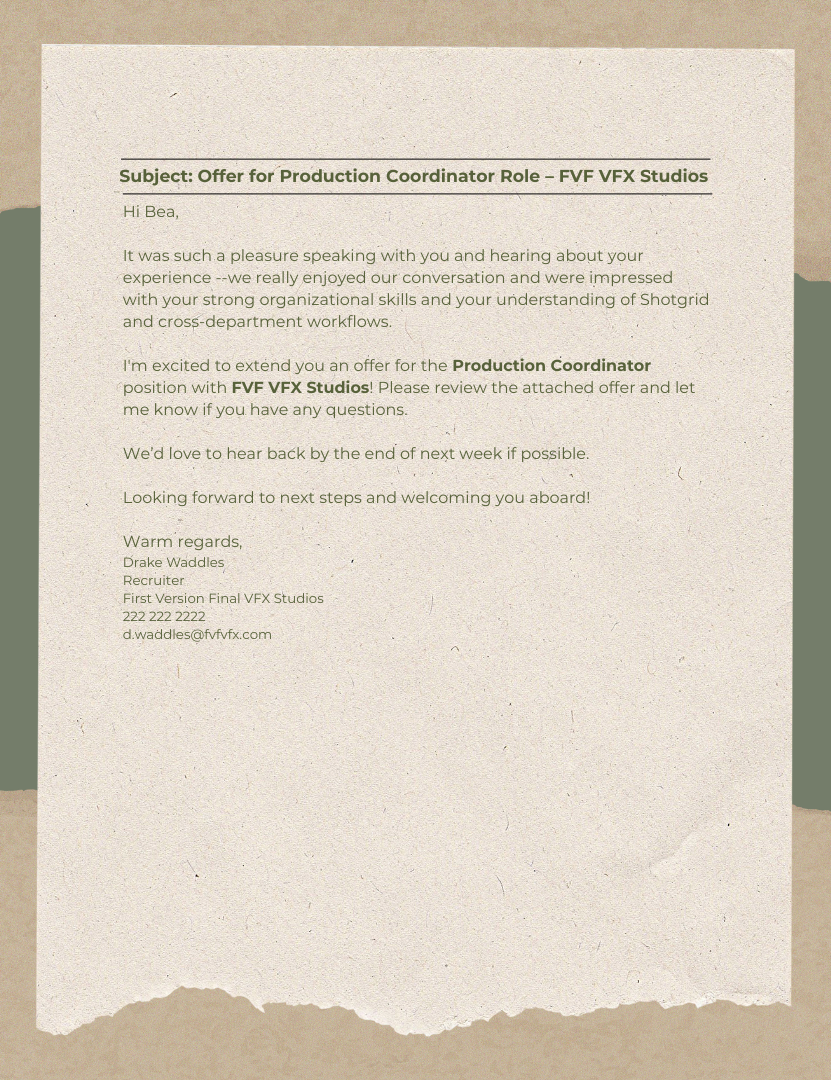
NEXT STEPS:
STEP 1: Send a thank you message to the organizer.
Don’t spam all the contacts cc’d in the calendar invite.
Forward your thanks for all attendees through the organizer.
3-5 sentences and mention something that was said in the interview.
STEP 2: Document the questions asked, your response, and what you would do differently next time. Good practice for your next interview.
STEP 3: Mark it on your calendar when to check in for updates.
IF YOU ARE SENT AN OFFER:
STEP 4: Read the contract. All of it. See if you agree.
STEP 5: If you have any questions about the contract, ask.
Contracts can be amended.
STEP 6: If you have ownership of content online or elsewhere that may be related to the work you do, make sure that there is a clause in the contract protecting your ownership.
STEP 7: Once everything is signed, sealed, delivered —celebrate!!
REMINDER:
Notes are based on your Camp Leader’s own experience and are not necessarily the only possible approach.
This course is just a guide and an example, not a bible.
Most interviews are also a vibe check.
To see if your personality will fit in with the team.
6.4: What to Do When an Interview Goes…South?
More times than not, it’s never as bad as you think. ;]
NEXT STEPS:
➤ Take a breath. Even the best of us fumble too.
A lot of times, it’s much worse in our head than it actually was.
And if not, that’s okay too. It became an opportunity to learn from.
➤ Learn from it. Write down the questions that made it hard.
Write what you said and what you would say next time and why.
➤ Send a thank you message.
➤ If you’re no longer interested, respectfully withdraw.
➤ Let it go. Hiring decisions are outside our control and beating yourself up for how it went doesn’t help anyone.
Remember the orientation: Every rejection is a redirection.
Even if it was the goal & dream, it’s not the path right now. Move on.

PROD TIP: Regardless of the outcome, always thank them for their time.
-
Non-graphic casual to business casual. Even for virtual interviews.
-
Casual but professional.
Our industry isn’t so formal that you must “henceforth address all as esteemed colleagues”.
-
Read the job description.
-
You can tag it to your thank you email.
-
no :]
But if I owned a studio, this is the current working name hahaha
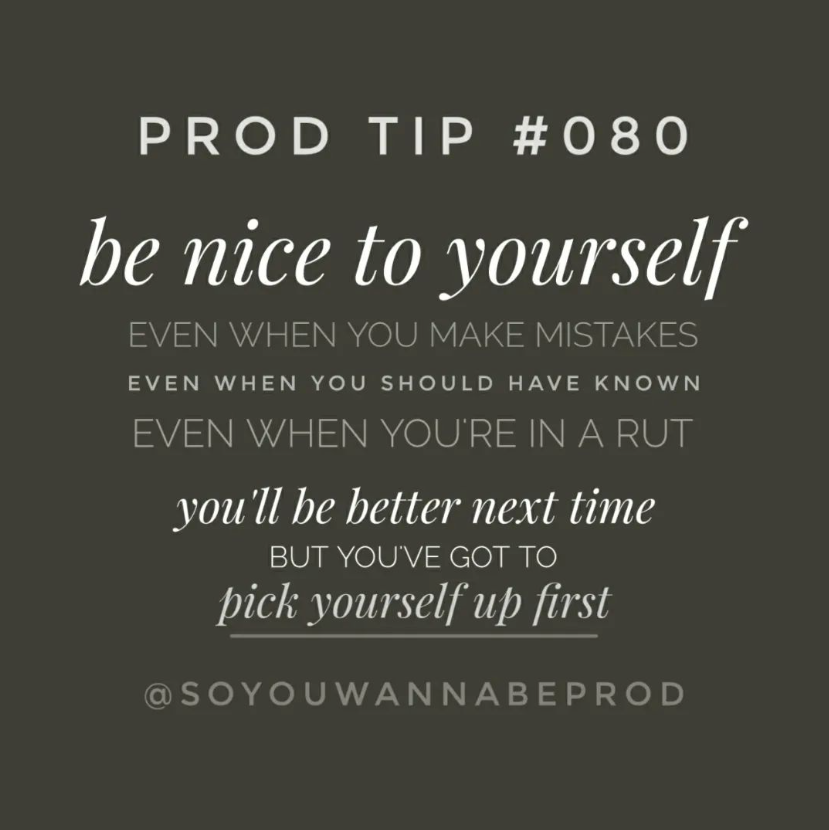
We are our own worst critics sometimes, and it's harder to let things go when you know exactly what you could have done better. Remember that your biggest supporter will always be yourself.
It's okay to feel let down and disappointed, but don't stop there.
A single event does not define you. Try again.
-
Relevant tips for production. Click on the number for more info.
—
#084: Be careful with what you say during job interviews.
#247: Sometimes, interviews are for personality checks.#305: Always thank people who refer you.
TIP: Make sure that there is congruency between what’s on your resume, cover letter, and what you say you are in your interview.
TIP: Never just wing an interview. Make sure to set aside time to prepare your environment, setup, answers, and questions for the interviewer.
TIP: For virtual calls, let them know what they can’t see. If you’re taking notes or have notes on another screen, let them know that that’s why you’re looking away from the camera.
TIP: If you are running late to an interview, communicate it as soon as possible to the meeting organizer.
TIP: Treat everyone with respect, not just the interviewers.
TIP: Let them know if you’re no longer available or interested in the job position.
TIP: Practice answering interview questions out loud.
TIP: Before the interview, you should know your favourite shows done by the studio, or values on their website that you resonated with.
TIP: Have your own resume handy to use as reference during the interview in case you blank out.
TIP: Even for virtual calls, remember to set your phone to SILENT before the interview.
TIP: Arrive or join the meeting early and test the meeting link ahead of time in case you need to update the app or your password.
TIP: Reserve a quiet place for the interview with a stable Wi-Fi. Let everyone else in your household know and make necessary arrangements.
TIP: When thanking the organizer for setting up the interview, include something specifically said in the interview. Don’t just copy and paste a generic email.
TIP: Don’t email all the contacts cc’d in the calendar invite. You might end up sending an email to someone who wasn’t even at the interview. Keep your communication only with whoever you’ve been in contact with when arranging the interview unless they’ve explicitly mentioned otherwise.
TIP: Learn from your interview. Write down the questions asked, what you said, and what you would do next time.
TIP: Create a reminder on your calendar for when to follow up for an update after the interview.
TIP: If you are sent an offer, read the full contract and don’t hesitate to ask questions. Contracts can be amended within reason.
TIP: Learn to let go. At the end of the day, the hiring decision is not OUR decision. It’s outside our control and we can only do the best we can. If it didn’t go as planned, that’s okay. It may just be not the path for you right now. Move on and try again —but try differently.
TIP: Regardless of the outcome, always thank them for their time.
-
Taking a break from the Campfire Stories today.
Your Trail Challenge is to practice answering the questions in Ch.6.2. Make sure to do it out loud!
Use the Common Interview Questions worksheet in your Gear Pack to help.
-
Here are the main takeaways from today’s camp.
How you present yourself before, during, and after an interview matters and takes proper planning.
Interviews are a way to prove in person what you say you are on your resume and cover letter.
Read the job description so you can echo the skills that interviewers are looking for.
Regardless of how an interview goes, there are lessons to be learned from both.
Always thank everyone who helped the interview happen.
-
SOY is not affiliated with the external links below, but these references are listed here in case they may be helpful to others.
—
Vanessa Van Edwards, The Science of People
Interview Tips by Erin McGroff, advicewitherin
Hype Playlist for Prod Interviews - COMING SOON
—
GUIDED TRAIL - COME WALK WITH ME!
Action Items:
No. 1: Fill out the worksheet: Interview Questions for Prod
No. 2: Create your own: Interview DAY OF CHECKLIST