
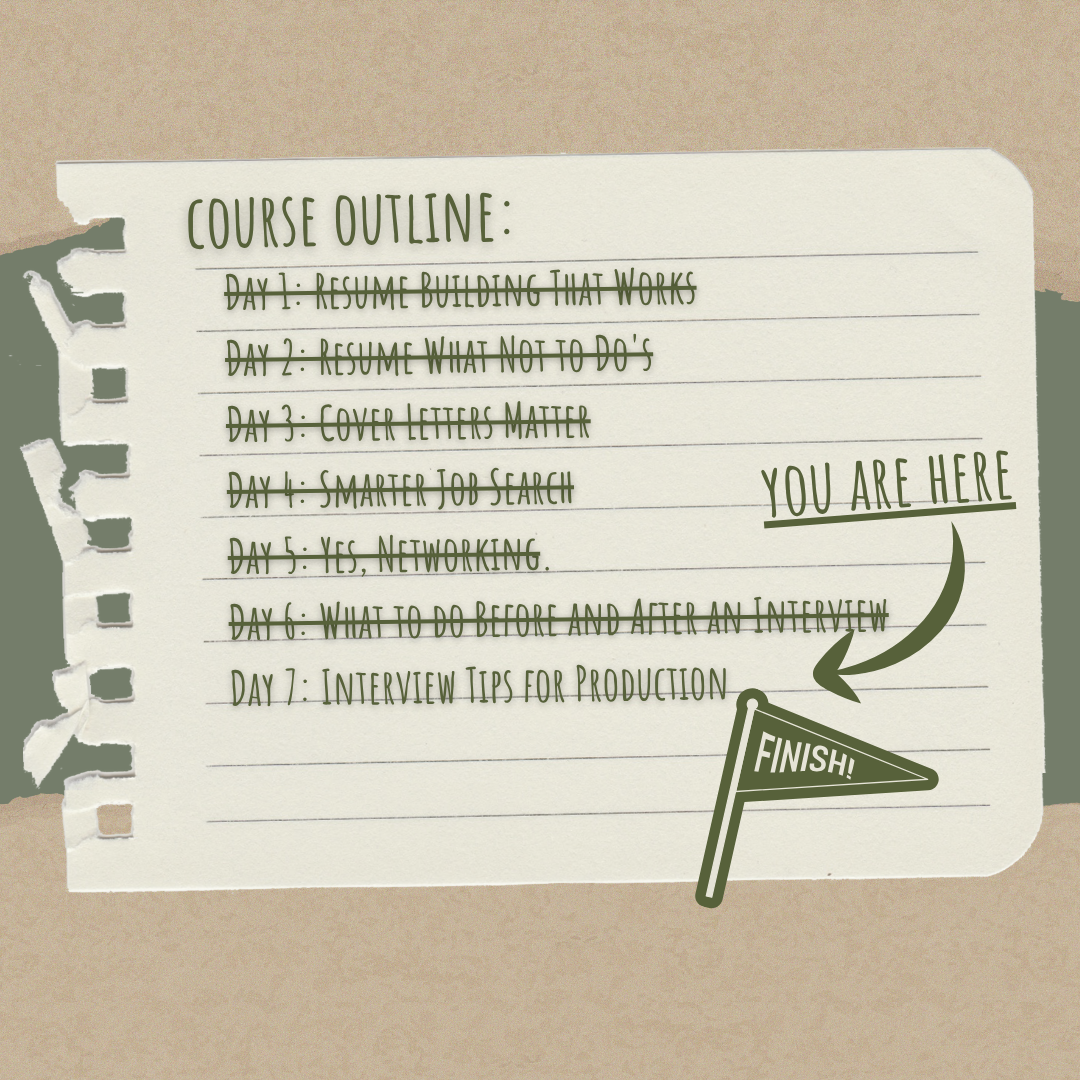
Day 7: Interview Tips for Production
IT’S NOT JUST A FORMALITY
Today’s goal is…
To learn how to deliver a strong interview for Production roles.
Gear Check:
• Prod Interview Cheat Sheet Template
7.1: Starting Strong
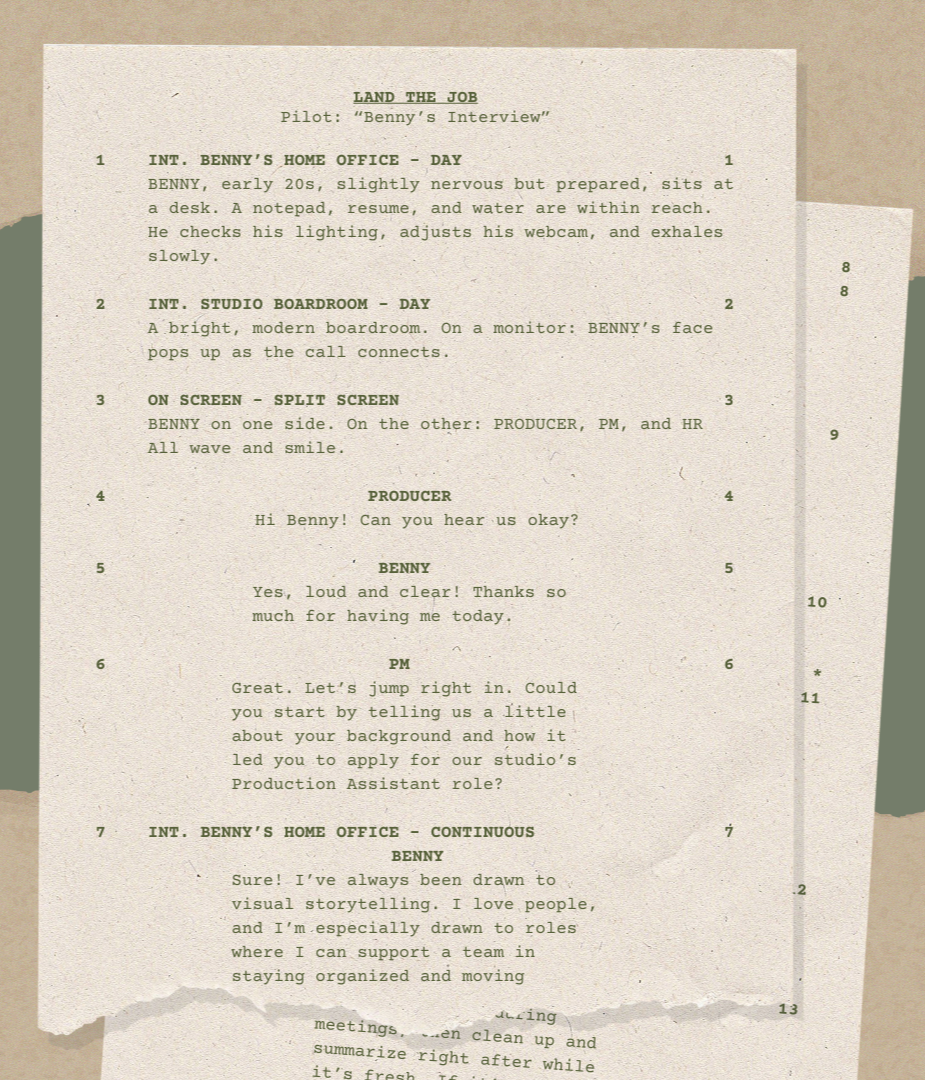
The interview starts way before it formally begins.
THE INTERVIEW STARTS EARLY
-
People take note of your demeanor, body language, and punctuality whether it’s in person or via call, and it anchors how they will perceive you for the rest of the interaction.
Being respectful of everyone along the way also matters because you never know who you might end up working with later on. How would you like them to remember you next time you meet?
-
From what your email is, to how your LinkedIn profile looks, to the tone and response time of your correspondence with the meeting organizer, all of which influence how they perceive you in terms of reliability and communication style.
Also a reason why ghosting someone is a big no-no —that is not an impression you want them to hold onto next time your paths cross.
-
As Prod, we facilitate meetings on the daily and small talk while we wait for everyone to join the meeting is often part of that.
So, the casual chats before the “formal interview questions” are not just fillers, but are a way to gauge your communication skills, personality, and how you’d fit in with the team.
-
For positions that require initial calls or multiple interview rounds, the early part of the process may feel informal, but it’s most definitely still part of your evaluation.
So, even if it’s only a 5 minute phone call, be enthusiastic, professional, and most of all, know the responsibilities of the job you’re applying for (and a bit about the studio) —which luckily are all in the job description! :D Seriously, read that stuff.
-
As mentioned in an earlier chapter, the industry is small, but also not. So, word travels fast and reputation matters.
You don’t know who knows whom, and for all you know, the people in the room that you’re meeting for the first time may already know a little more about you beyond what’s on your resume —hopefully the stories that come with your name are good things. Regardless, this is also why setting the tone at the start of your interaction matters even more. Show them how you want to be known or remembered.
IMPORTANT NOTES:
-
These tips are meant to help build awareness —not to stress you out or make you feel like you have to perform a certain way.
We all show up differently, and if some of these don’t feel natural, or don’t come easy to you, or just are not how your brain works best, that doesn’t make you any less professional, capable, or worthy.
You bring your own strengths, and those absolutely matter, too.
The notes in this chapter are not so much a checklist of “what’s right” but more so a reference to navigate with more confidence in a world that sometimes expects everyone to show up the same way. Our hope is that in sharing what is commonly “expected,” you will be able to better prepare for future interactions with potential employers.
-
These interview expectations aren’t universal and social norms vary across companies, countries, and cultures.
What’s confident or professional in one place might be odd or rude elsewhere. (e.g. In some cultures, silence is respectful, not awkward)
These notes are based on most interviews in North America, but that doesn’t make them right for everyone everywhere —they might even feel contradictory to your own cultural norms and that’s okay.
The goal of this chapter is only to navigate with awareness. As always, this course is only a guide, not a bible. Besides, one of the best advice I was given for an interview was “to be yourself.” It was only much later in life that I learned the wisdom in that, and that is, the best place to work at is always the place where your authentic self is welcomed and celebrated, and where you feel like you belong.
First impressions count BIG time.
It sets the tone not just for your next chat, but even for the rest of your future interactions.
First impressions are very hard to rewire, so take care to be at your best right from the beginning.
7.2: Mapping Out a Typical Interview
Here’s what you can expect and what you can do at each phase.
PHASES OF AN INTERVIEW
TOTAL DURATION: About 30-45 minutes
INTRODUCTION: 5 minutes
➤ EXPECT: Small talk, tech setup, waiting for everyone to join.
➤ TIP: Set the tone. When in doubt, be the first to greet them.
INTRODUCE YOURSELF: 2 minutes
➤ EXPECT: Start of formal questions. Usually “tell us about yourself.”
➤ TIP: Have this bit ready before the interview and well rehearsed.
Find a way to mention your connection to the studio. You can share your referral’s name or what about the studio you really liked. Both!
OTHER FORMAL QUESTIONS - IN NO SPECIFIC ORDER: 10-15 minutes
(for sample questions, see Ch. 6.4)
➤ EXPECT: Questions about your experience, resume, past roles.
➤ EXPECT: Questions that build on your answers. For context or details.
➤ EXPECT: Situational questions like “tell me a time” “how would you”
➤ EXPECT: Questions about tool familiarity like “ShotGrid” or “Sheets”
➤ EXPECT: Questions about pipeline knowledge. Past departments.
➤ TIP: Share highlights. Know your resume enough that you’re able to expand on or briefly summarize your full career history as needed.
➤ TIP: Give specific details with your answers not just fluff. Share the team size, episode/shot count, length of time, departments, etc.
➤ TIP: Review the job description. Prepare go-to stories that reflect skills from the job listing and echo them as you share your stories.
DO YOU HAVE ANY QUESTIONS? 5-10 minutes
➤ EXPECT: They will always ask this.
➤ TIP: The answer is always YES. Even if they answered your Qs along the way. This is why you should have a few prepared ahead of time.
➤ TIP: Ask your prepared Qs or ask to clarify something they said.
PROD TIP: Write down their names during the interview.
Sometimes, not everyone on the invite is able to join, but you will need to know who was there when you follow up.
NERVOUS? That’s totally normal! -
Remember: You already qualify for the position. They read your resume and liked what they saw —that’s why you’ve been invited! Now, you just have to say your skills and experience back to them.
Keep a copy of your resume or have your LinkedIn profile open for reference and guide when speaking about your experience.
Take 6 deep breaths before you join the meeting.
Practice WELL before the interview so that your answers come more naturally to you and easier to repeat or use in an answer in case you accidentally lose your train of thought.
The trouble with memorizing a script is that when you happen to say the wrong word or in the wrong order, you can get flustered and forget what you wanted to say altogether.
Pause. Breathe. Take a sip of water. Seriously. I do this in meetings too. That short second(s) you take to take a sip of water does wonders in resetting and clearing your mind just enough to formulate a more coherent response.
You can SAY “let me take a moment to gather my thoughts.”
It’s actually expected —we want you to be thoughtful in your response and not just bluff for the sake of having something to say.You can repeat the question back to them to:
- clarify that you understood the question
- buy yourself time to gather your thoughtsRemember that YOU’RE interviewing them too. For some, reframing it this way where you are both assessing if this is a good match helps lessen the pressure.
There’s a follow up email to add anything you forget to say. Thank you emails are not just formality and gratitude, they’re also a chance for you to share anything you might not have expressed clearly (or at all), or ask questions you didn’t get to ask.
Don’t forget to show your personality!
…even if they don’t smile, it’s okay.
Showing up the best you can is what matters.
7.3: Common Mistakes in Interviews
Here are a few things to avoid during an interview.
INTERVIEW NO-NO’S
✘ Joining the meeting late without any notice.
✘ Not researching the company.
NEVER say “i don’t know anything about the studio.”
✘ Not researching the role or reading the job description.
✘ Not answering with skills/experience related to the job.
Aka “Always. Read. The Job Description.” and tailor your answers.
✘ Not answering with skills/experience related to the job.
✘ Not answering with stories or specific examples.
Don’t just say what they want to hear. Back it up with your experience.
Buzzwords have no weight without substance.
✘ Not knowing anything about the VFX or animation pipeline.
Even if you have no experience, there are TONS of free resources on YouTube and some studios even have pages going over the basic overview of each department. Research ahead of time.
✘ Not being mindful of the time. Rambling and going off-topic.
✘ Speaking poorly about past employers.
This is a reflection of your character. Never do this. Ever.
✘ Not preparing for interview questions. It shows.
✘ Not asking questions at the end.
Why not ask about when you’ll be able to hear back?
✘ Not being your own timekeeper. Not acknowledging if the interview is feeling like it may go overtime and then letting it go past it.
-
Be honest.
If the question is unclear, let them know. They’re happy to elaborate or rephrase if you are not understanding the question fully.
If you have not had enough experience to answer the question, say that and then follow up with what you would do if you were in that situation based on your current experience or with what you know right now.
-
Absolutely! Hello? We’re Prod, note-taking is part of life.
A producer I used to work with actually mentioned that it’s a bonus point if you do! So let them know if you’re taking down notes —especially when it’s virtual and they can’t see it offscreen.
-
Wait until they bring it up or when you have an offer. This way, your questions regarding the topic are also informed.
It’s possible that they may ask for an expected salary range, so you should also come prepared with research on typical rates for the role. Check job listings from other studios or reviews in Glassdoor.
-
Aim for 1-2 minutes. Make sure that your answer is relevant and that you’ve answered the question. If you must give context, keep it short and get to the point quick.
-
Let the organizer know as soon as possible.
If you have their number, that might be more effective than an email due to urgency.
Let them know how long, if it’s okay to start X minutes late, or share your next availability if you need to reschedule —for the latter, I’d say at their earliest convenience and not necessarily yours.
-
Yes. The sooner you let them know, the better.
-
Own it. Let them know that you want to try again :)
It’s okay. Interviews are high-stress situations and we understand that nerves get the best of us sometimes.
It’s better to take a quick pause, breathe, and try again with a cleaner slate than try to patch up an already “wrong” answer along the way —that just snowballs into a messier and unclear response which will hurt your chances more than just restarting.
Production’s biggest skills are in communication and you can display this by taking the steps YOU need to ensure that you are passing on the information as clear as possible.
For more tips on what to do before and after the interview…
PROD TIP: Don’t forget to thank everyone in the call or meeting before you leave the interview. Prod is always ever so busy, so taking some time out of their packed calendar is a gift too.
DID YOU KNOW?
Your interview doesn’t stop at the end of the meeting. Be sure to follow up with the organizer afterwards via thank you email.
“Resumes get you through the door, but interviews are what keep you in the room.”
7.4: Always Ask Questions
Start the interview strong and leave a lasting impression.
WHY IT MATTERS:
Questions to Ask
You don’t have to ask ALL of these —just sharing ideas!
-
These are questions to get further details on anything said previously.
Examples:“Just to make sure I understand correctly, earlier you mentioned X…<insert your question about it>”
“Could you expand a bit more on…”
“When you mentioned X, I was wondering <insert your question>”
"When we were speaking about X earlier, I wanted to circle back and ask <insert your question>
If there’s a workflow that you’re curious to know more about based on the conversation you just had, ask if they can explain.
-
Not all answers come after a question. Sometimes, YOU create the opportunity to shine and let your skills/experiences be known.
These questions are designed for you to naturally bring up other relevant skills that you may not have had a chance to speak about earlier.
( PROD TIP: Bad interviewers exist too! Maybe for my next course, haha! )
Examples:“On the topic of X earlier, would an experience in <insert your past experience> be relevant? I thought it might be because in this role, I <insert your skills and why you thing that’s helpful>. “
“I lost my train of thought earlier and just now remembered more of what I wanted to say, do you mind if we circle back on <insert topic + answer>”
On your company website, I really resonated with <values/mission/culture> how would you say that is reflected in day to day of this role? If I were in this position, how can I help champion that within the team? (And then if you agree share how you've done something similar in the past ).
Ask them what their favourite day at the company is like and why? Or what typical day of this role is like? Get a glimpse of culture and work environment.
“What challenges are the dept/team currently facing? If I were to start this role today, what would be the most impactful way I can help with in the team? What would be my priority?” Forces the interviewers to imagine YOU already in the role and opens an opportunity for you to share other past exp/skills that you didn’t get to share in earlier questions. Also already shows proactiveness and problem solving mindset --just by asking the question itself.
“What differentiates employees who do a great job from those who do a good job in this role? What would you say is the most important skill for somebody to succeed in this role and with the current team? What is the most challenging task for this role?” All of these give insight on performance expectations and then YOU can bring up how you’ve had something similiar <insert your stories + skills>
-
Is this environment or project a fit for YOU? That’s a valid question to ask yourself too. We spend so much of our lifespan working —I argue that this should be something we all need to ask ourselves more often.
Examples:
How big is the team? What’s the WFH arrangement? Preferred line of communications? Good way to gauge what work/life balance will be like, how organized the team is, or how flexible a company is with work/life arrangements.
Who does this role report to? Get a glimpse of their structure,
If there's any topics/industry news or changes that you care about, ask what their take on it is, how it affects the team, how this role's responsibilities are affected by it etc.
What is the onboarding process like? Make sure that you’ll be set up for success too!
If you're looking for career growth, what does that look like in the studio? Who would be your mentor? How are your successes celebrated? Or how is performance feedback shared? Sometimes, asking these questions give you an idea of if working at this place will make you feel fulfilled.
What activities/events does the studio have that is not directly Production, but meant for team building/culture? Especially important if studio is 100% WFH. Are YOU okay with that? Different people have different preferences.
-
Always ask what the next steps are and what to expect and when. When you have this info, it makes it easier to contact them later to check in and follow up on what they said they'd do.
PROD TIP: BEFORE you ask these questions, thank them for their time. This way, you also don’t forget in case you get pressured to wrap up.
“I’d love to know what the next stages are from here.”
“Do you have a general timeline for when candidates will be notified?”
“Before we wrap up, may I ask what the next steps are and when might I expect to hear back?”
✓ It shows genuine interest in the role and in the studio.
✓ It shows preparedness and you have an idea of what the job is.
✓ For a Production role, it shows if you’re one likely to be inquisitive and curious —something that goes a long way on the job if hired.
✓ It’s an opportunity for you to learn more about the role, pipeline, studio, and the expectations to succeed in similar roles, which may not be apparent in job descriptions alone.
✓ It’s a chance to gauge if this is a right fit for you.
✓ You can verbally highlight what you want them to take notice of in regards to your resume or experiences/skills. In case you feel you didn’t get to do this enough especially if you think you “messed up” answering an earlier question.
✓ You can let your personality shine outside of a “formal Q&A.”
✓ It leaves a stronger final impression. How it ends sticks.
“The best Production peeps are problem solvers, and to be a problem solver, you have to be curious, and to be curious, you have to be asking questions.”
REMEMBER:
YOU are interviewing THEM too!
Use this chance to find out if THEY are a good fit FOR YOU!
-
Relevant tips for production. Click on the number for more info.
—
#084: Be careful with what you say during job interviews.
#247: Sometimes, interviews are for personality checks.TIP: Make sure that there is congruency between what’s on your resume, cover letter, and what you say you are in your interview.
TIP: Never just wing an interview. Make sure to set aside time to prepare your environment, setup, answers, and questions for the interviewer.
TIP: For virtual calls, let them know what they can’t see. If you’re taking notes or have notes on another screen, let them know that that’s why you’re looking away from the camera.
TIP: If you are running late to an interview, communicate it as soon as possible to the meeting organizer.
TIP: Have your own resume handy to use as reference during the interview in case you blank out.
TIP: Even for virtual calls, remember to set your phone to SILENT before the interview.
TIP: Arrive or join the meeting early and test the meeting link ahead of time in case you need to update the app or your password.
TIP: Learn from your interview. Write down the questions asked, what you said, and what you would do next time.
TIP: Don’t forget to ask when you can expect to hear back.
TIP: Regardless of the outcome, always thank them for their time.
TIP: If you ever get me as an interviewer, I’m always more partial to candidates who ask questions than those who do not. ;)
-
Anecdotes from the real life.
—
Always check meeting links BEFORE the call starts. I once got LOCKED OUT of a Zoom meeting just before the interview because I entered my password incorrectly one too many times. Panic ensued.
In another interview, Zoom decided that the best time to update the app was 5 minutes before the interview was about to start. :’]
I actually dread small talks —because I’m terrible at it. So bad that yes, I do often end up talking about the weather lol. But I still try because practice helps and the more I get a chance to do it, the more “natural” I can hopefully sound on the next one —and I can steer clear of yet again mentioning how the rain is a Vancouver experience, aha. And in a way, during an interview, it distracts me from my nerves and getting so nervous that I forget what to say.
I went for a virtual interview thinking everything was set up perfectly with no hiccups —until my physical phone rang out loud in the middle of the interview. I was not muted so they definitely heard it.
-
Here are the main takeaways from today’s camp.
First impressions matter a lot and that begins even before the first formal interview question is asked. So, be enthusiastic and always come prepared. Your first interactions shape how they will perceive you for the rest of the meeting.
The majority of the time will be spent on introducing yourself (a resume walk thru) and answering questions. Come prepared by practicing your answer to the common interview questions.
Always read the job description to gather the skills required for the job, and make sure to mention that you have these skills during the interview.
Bring up past situations as examples of how you exhibited the skills you mentioned in no.3.
NEVER not have questions at the end of the interview.
-
SOY is not affiliated with the external links below, but these references are listed here in case they may be helpful to others.
—
Video by Amri Celeste, Interview Coach
Video by Emily Yakashiro, A Course in Production
Video of Amy Cuddy, TED Talk
—
GUIDED TRAIL - COME WALK WITH ME!
Action Items:
No. 1: Write a 1-2 minute About Me intro going over your experience.
No. 2: Write 3 go-to stories that show off your skills.
No. 3: Write 5 questions to ask at the end of the interview.
No. 4: Finish the bag of treats! Yay you did it! I’m proud of you :)